


Urban Heat Islands

Updated: Apr 29
By: Nadia Hossain
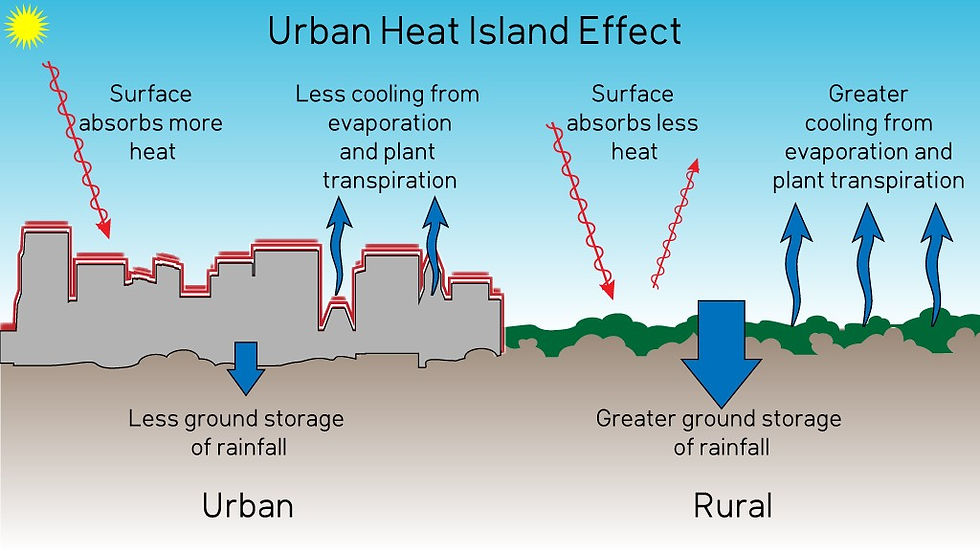
Why does the city feel hotter than the countryside? The answer lies in the concrete jungle in front of you. As temperatures climb, a phenomenon called the "urban heat island" makes cities and suburbs significantly warmer than nearby rural areas. According to the U.S. Environmental Protection Agency (EPA), daytime temperatures in cities can run 1 to 7°F hotter than their greener surroundings. At night, some urban areas stay as much as 22°F warmer than rural zones, as heat absorbed by buildings and roads during the day slowly radiates back into the air.
What exactly are they? Heat islands are urbanized areas where buildings, roads, and other infrastructure create pockets of higher temperatures compared to the natural landscape around them. They form wherever nature is replaced by hard, dry surfaces. Cities like Dallas, Houston, Phoenix, Los Angeles, and San Diego have particularly intense heat islands due to their hot climates. But even northern cities like New York, Chicago, and Detroit experience the effect thanks to dense buildings that trap heat and block cooling winds. Not every part of a city is the same though. Suburban neighborhoods that contain parks and trees stay noticeably cooler than the busier downtown or high rise concrete areas. Satellite technology, including NASA's Landsat satellites, can map these temperature differences in real time, showing heat exactly where buildings and roads are most concentrated.
What is the environmental impact? The effects go beyond uncomfortable commuting paths. As temperatures rise, people crank their air conditioners, which in turn pump even more hot air outdoors, creating a perpetual cycle. Demand on hot weekday afternoons can strain electrical utilities, leading to blackouts or brownouts. That extra power generation releases more air pollutants and heat-trapping gases like carbon dioxide. Ground-level ozone forms more easily, creating the hazy smog that hangs over many cities. Heat itself is a direct health threat. Older adults, young children, and people with existing medical conditions are most vulnerable to heat stroke and heat exhaustion. Every year, several hundred Americans die from heat-related causes. In addition, rainwater that falls on scorching pavement warms as it runs off into storm drains. That heated runoff flows into urban streams, ponds, and lakes, raising water temperatures and stressing fish and other aquatic life adapted to cooler conditions.
How do we reduce impact? There are several tools that individuals can utilize. Trees and plants cool the air by providing shade and releasing water vapor through their leaves. When more trees are planted, the surface temperatures will also drop as the asphalt will not heat up as quickly. In cities where there are less areas for planting, rooftop gardens are a great way to turn heat-absorbing surfaces into cooling green spaces. With the reduction, people’s utility use can also go down. The way buildings are arranged also matters. Tall structures block air circulation, trapping heat.Thoughtful city planning that allows wind to flow through can help hot air escape with the addition of more vegetation. In planning, implementing the use of "cool roofs" and "cool walls" are a way to reflect sunlight instead of absorbing it.
Special cool paving materials work the same way on streets and parking lots. Some permeable pavement designs also help storm water drain more effectively. Heat islands are not an unsolvable problem. With more trees, smarter building materials, and green roofs, cities can lower their temperatures, save energy, protect vulnerable residents, and keep urban streams cooler for wildlife. You can start small by opening a window instead of using the air conditioner, planting anything from flowers to veggies, participating in community gardens, painting outside structures with brighter colors, creating a mini green garden for your windowsill, etc.


Comments